Data room · updated 10 August 2026
A card-sized AI-native device and service for the 2.7 billion people who work away from a desk.
Private. Please don't forward without asking — there are named counterparties on this page.
In one paragraph
Where this actually stands.
chit is a $129 machined-aluminium card with one button. Press it, talk, and chit turns what was said into records, expenses, calendar events and follow-ups — interpreted through who you are and what you do. Two SKUs are in production artwork, the tooling is ours, and physical units exist. The software is a live iOS app. The store is built and verified end to end through Stripe, in sandbox; live payments switch on when we claim the resource, so nothing has been charged and chit is pre-revenue. Twenty co-branded devices are specified and connected to Flexbone's own VPC, and Flexbone's CEO will take a reference call. We hold four signed letters of intent covering 285 units — one of them a company a founder owns, disclosed below — before spending a dollar on acquisition. The company is a Delaware C-Corp with no outside capital and no prior instruments, and the founders have put in $10,000 of their own; we are raising $200,000 on a post-money SAFE at a $4M cap to fund the first production run and three revenue-share channel pilots.
- 285
- units of verbal interest
- unsigned · 70% one customer
- 4
- signed LOIs
- non-binding · one related party
- 20
- devices branded and connected
- Flexbone
- $0
- revenue
- pre-revenue, and pre-launch
Traction
What is actually true today.
In the order a sceptic should read it: what is deployed, what is signed, what is only spoken, and what is built.
- Deployed
- Twenty co-branded chit devices with Flexbone Solutions — specified, branded as Flexbone's own, and connected to Flexbone's VPC. The architecture is live; we are not claiming twenty people in daily field use, because we have not measured it.
- Signed
- Four executed letters of intent — Flexbone Solutions (healthcare AI), Triple C (logistics, a related party: a founder owns it), Magnetism Motors (automotive retail) and Stuart Pro HVAC (trades). All non-binding. Executed copies available on request.
- Spoken
- 285 units of verbal interest across those four operators. No purchase orders. No deposits. The per-organisation split, the customer concentration inside it and the related-party share are all set out in the demand section below.
- Built — hardware
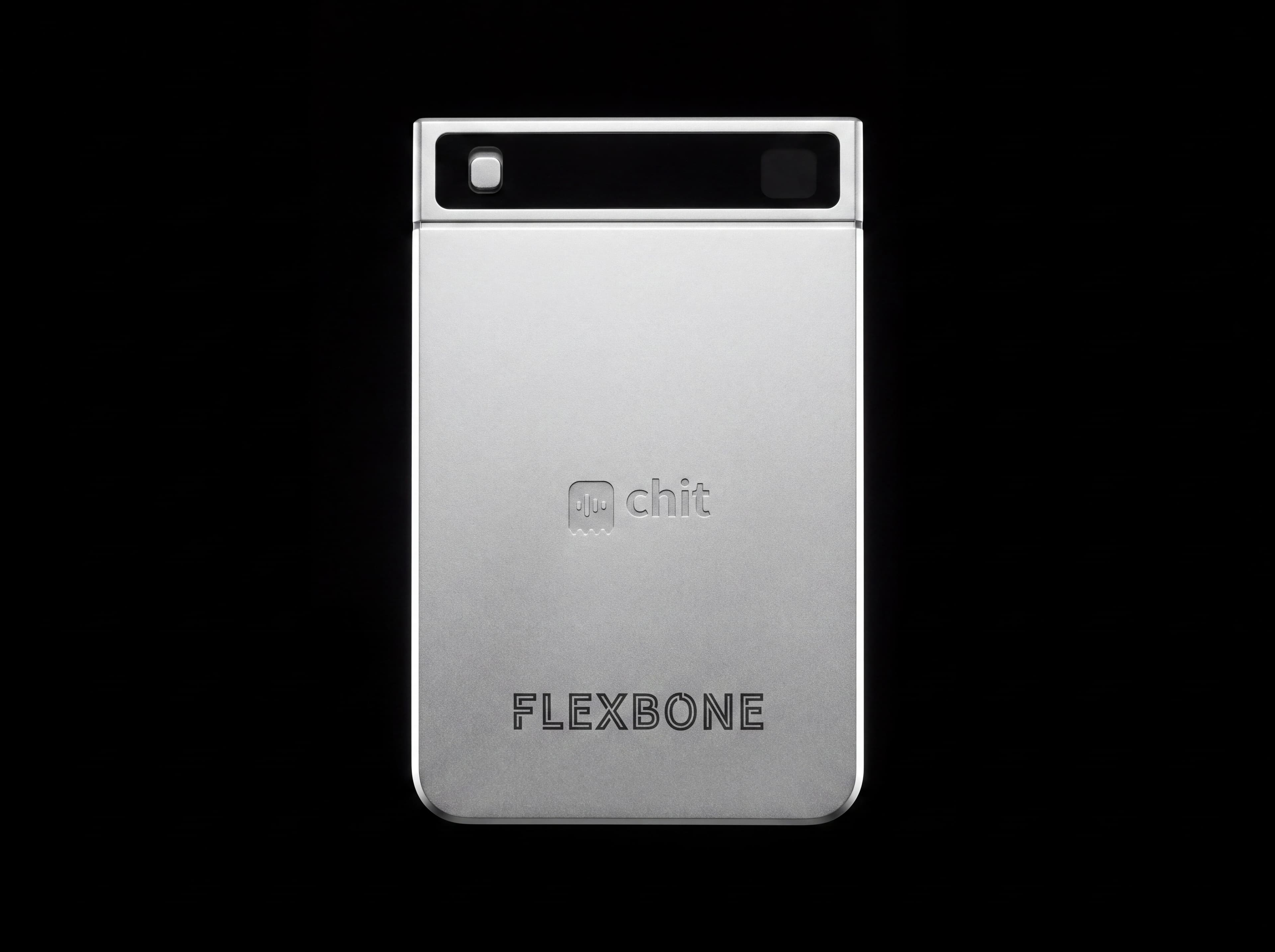
- chit one and chit one Pro in production artwork with the factory as of July 2026, drawn 1:1. Physical units exist and have been photographed for the store.
- Built — software
- A live iOS application: recording, transcription, context-framed summaries, the daily brief, search across everything captured, calendar and mail connections, and export to plain text and markdown. The founders' own status line is “software done, production units inbound.”
- Commerce
- hichit.com configures and buychit.com charges — a real Stripe Checkout session with the device as a one-time line and the $9 membership as a subscription trialing fourteen days. Built, deployed and verified end to end in Stripe's sandbox with a test card: $129 collected, subscription trialing, US shipping captured. Live payments switch on when the Stripe resource is claimed; that has not happened yet, so no real card has been charged.
- Revenue
- Zero. chit is pre-revenue: no customer has been charged, because live payments are not switched on yet. Every dollar spent to date has been the founders' own.
- Waitlist
- There isn't one. An early version of the site had a waitlist form; it came out when the storefront was rebuilt, and the database behind it was never connected. So there is no signup list to quote and no email list behind it — the 285 units below came out of conversations, not a form. The store takes real orders instead, which is the number that will matter once live payments are on.
Demand
285 units, before we started.
285
units of verbal interest across four operators, ahead of launch, with no acquisition spend
Read this with the number
These are conversations, not orders. Nothing here is signed, no purchase orders have been issued, no deposits have been taken, and no delivery dates have been given. Every one of these operators can walk, and some will. We count them because they arrived without a marketing budget, a launch, or an open preorder page — from people who run the businesses chit is built for, several of whom have held the device.
Where the interest sits
- Flexbone SolutionsHealthcare AI — MSPs and NPs · Rollout over a year, contingent on this round
- 200
- Triple CLogistics — related party · Drivers first, then brokers
- 50
- Stuart Pro HVACHVAC and trades · On-site employees
- 25
- Magnetism MotorsAutomotive retail · Sales agents and floor manager
- 10
Two things to read off that table rather than discover later. First, concentration: 200 of the 285 units — 70% — are one customer, and that customer's rollout is explicitly contingent on this round funding it. Second, relation: Triple C is the carrier one of the founders owns and operates, so 50 of those units are a related party and should be discounted accordingly. Excluding both, arm's-length third-party interest is 35 units.
What we would tell you not to believe
We have no conversion history to point at, so we are not going to hand you a percentage. The honest position is that unsigned verbal interest from a pre-launch hardware company converts at an unknown rate, and the first production run exists partly to find out what that rate is.
Letters of intent
Four signed. All non-binding. One is a related party.
Summaries below. Executed copies are available on request — we do not publish a counterparty's signed letter on a page they did not agree to appear on, and neither should anyone else.
Flexbone Solutions
Healthcare AI · flexbone.ai · Non-binding
- What is in place
- Twenty co-branded chit devices, specified and branded as Flexbone's own hardware, connected to Flexbone's own VPC so audio, transcripts and briefs stay in their cloud. The letter looks past those twenty to roughly 200 units across their MSPs and nurse practitioners, rolled out over a year — a rollout that needs this round to execute.
- Units
- 20 specified and connected · ~200 intended
- What the letter says
- Executed 29 July 2026, signed by Sayem Hoque, CEO. Flexbone will take a reference call and has agreed we may quote them.
Triple C
Logistics · RELATED PARTY · Non-binding · related party
- The disclosure first
- Triple C is the hundred-plus-truck carrier that co-founder Ahmad Agad owns and operates. This letter is therefore a founder's own company signing with chit. We put it on the page because it is real distribution into a launch vertical and because leaving it off would be worse — but it is not arm's-length validation, and no investor should read it as such. The use is drivers first, capturing what happens on a run, then expanding to the brokers Triple C works with.
- Units
- 50 devices
- What the letter says
- Executed copy available on request. Treat the commercial terms as related-party terms; they were not negotiated at arm's length.
Magnetism Motors
Automotive retail · Non-binding
- What they want it for
- Ten devices: sales agents carry one on test drives so what was said in the car survives the drive, and the manager reads sentiment across the floor from the captures rather than from the CRM. Dealership conversations are where the deal actually happens and where the CRM is blindest — and one of the founders operates an independent dealership, so this is a vertical we know from the inside.
- Units
- 10 devices
- What the letter says
- Executed copy available on request.
Stuart Pro HVAC
HVAC and trades · Non-binding
- What they want it for
- Twenty-five units across their on-site employees, to track the day and the meetings in it. An HVAC tech runs six to eight residential calls a day and says the quote out loud at the unit — the diagnosis walkthrough, the repair-versus-replace approval, the parts needed, the callback note. chit turns that into the ticket before they leave the driveway and gives the operator approval recordings that end he-said/she-said invoice disputes.
- Units
- 25 devices
- What the letter says
- Executed copy available on request.
A letter of intent is a statement of interest, not a contract. None of these obligate the counterparty to buy anything, and none should be read as booked revenue.
Case study
Flexbone put their name on our card.
The clearest evidence that the enterprise motion is real: a company that took our hardware, branded it as their own, and pointed it at their own cloud. What it has not yet done is generate revenue — that is stated below rather than buried.
- Who they are
- Flexbone Solutions (flexbone.ai) is an AI company working with healthcare customers. Their teams sit in rooms with those customers and the substance of the engagement — what was asked, what was promised, what was decided — lives in conversation.
- The problem they had
- Notes taken after the fact are the notes someone remembered, not the ones that were said. Across a team and a customer base, that is a compounding loss: nobody has a reliable picture of what is actually happening in the rooms, and the detail that mattered is gone by the time anyone needs it.
- What is in place
- Twenty chit devices specified and branded as Flexbone's own hardware rather than ours, and connected to their environment. One button, in the room, no laptop open and no app to launch mid-conversation. The letter looks past those twenty to roughly 200 units across their MSPs and nurse practitioners over a year.
- Where the data lives
- Every capture lands in Flexbone's own VPC. The audio, the transcripts and the briefs stay in their cloud — we do not hold them. The intelligence layer is customised to their operation rather than the consumer default, so the same sentence is read the way Flexbone's business reads it.
- What it does for them
- Their teams track notes across healthcare customers and pull data insights out of what was actually said in the room, rather than out of what someone typed up afterwards.
- 20
- devices branded and connected
- ~200
- units the letter intends, over a year
- Their VPC
- where every capture lives
What this does not yet prove
- Flexbone is not paying us today. The twenty devices are specified, branded and connected; the roughly 200-unit rollout across their MSPs and nurse practitioners is what needs this round to execute. So this is a real commitment and zero revenue at the same time, and both halves are true.
- We are not claiming daily active use. The devices are specified and connected to their VPC; we have not measured how many are in someone's hand every day, so we are not going to quote a number we do not have.
- Flexbone will take a reference call, and has agreed we may quote them. That is the check worth making — it is worth more than this whole page.
- One deployment is one deployment. It shows the VPC architecture works and that a company will put its own brand on our hardware. It does not yet show that this repeats, and 70% of our verbal interest sitting with this one customer is a concentration you should price.
Why we lead with it
The enterprise version of chit is not a bigger consumer sale. It is co-branded hardware, the customer's own cloud, and an intelligence layer shaped to their business — a deployment a competitor cannot answer by shipping a cheaper recorder. Flexbone is the first instance of that motion, with the architecture standing up and a signed intent to scale it.
Product
What is built, and what is not.
Hardware
- chit one
- 53.9 × 86 × 3.9 mm, machined aluminium, ID-1 card footprint. $129.
- chit one Pro
- 57.9 × 88.1 × 6.7 mm, diamond-cut faceted face. $179.
- Finish
- One: bead-blasted natural anodised aluminium. Confirmed against photographs of the physical unit.
- Factory
- Deliberately not named here. The manufacturing partner is not disclosed in anything shared over an open link — this page included — because that relationship is the one piece of this business a competitor could act on directly. Named under NDA, on request, in a conversation.
- Evidence of the relationship
- Both SKUs exist as 1:1 manufacturing drawings from the partner and as physical units — the photography across hichit.com is of the real M5, not a render.
- Tooling
- Owned by chit. The tooling is ours, not the manufacturing partner's, so the SKUs move if the relationship does.
- Lead time
- Built to order today, at roughly three weeks from order to delivery — the figure the store quotes to customers — and expected to come down as volume rises. Pending confirmation against a production run rather than samples.
Software
- Recording and transcription (Deepgram today)
- Context-framed summaries — set at first open, per person and per trade
- The daily brief: the day gathered into one page
- Calendar connections — Google, Zoom, Teams
- Mail connections and drafted follow-ups
- Search across everything captured
- Export to plain text and markdown
Each of those was confirmed by the founders against the build on 29 July 2026: the daily brief is built; calendar covers Google, Zoom and Teams plus custom integrations; mail covers all providers; capture is button-only with no wake word and no always-on microphone; and search across everything captured is included in the $9 rather than an upsell.
Model-agnostic by design: transcription runs on Deepgram today and the architecture is BYOM, so an enterprise can bring its own model. The enterprise deployment puts capture, transcripts and briefs in the customer's own VPC — GCP, AWS or Azure.
This is a live iOS application, not a clickable prototype — the list above is what runs in it. Android is not built.
Recording, consent and privacy
chit has no wake word and no always-on microphone — the firmware cannot record without the button being pressed. That is a deliberate design decision and it is also the single biggest regulatory difference between chit and an always-listening wearable.
What is already committed to, in public
- Capture is button-only. No wake word, no always-on microphone, and the display shows when it is capturing — founder-confirmed against the firmware, not a marketing line.
- Any capture can be deleted in one tap — audio, transcript and summary together.
- Voice is never sold and never used to sell anything.
- Calendar and mail connections are opt-in per account and revocable at any time.
- Card details never touch our servers; Stripe handles checkout on its own pages.
- Site analytics run through Google Tag Manager. The device and the app are not part of that measurement.
Three parties touch anything today: Deepgram for transcription, Stripe for payments, and Google Analytics for website measurement only. In an enterprise deployment, capture, transcripts and briefs sit in the customer's own VPC rather than ours.
The plain-English commitments above are live at hichit.com/privacy. The formal policy is being prepared with counsel; until it ships, deletion requests and questions go straight to a founder.
All-party consent
About a dozen US states require every party to a conversation to consent before it is recorded, and chit's buyer is someone who presses it in a customer's kitchen. Press-to-record with a visible capture indicator is the design baseline and a materially better starting position than an always-listening wearable — it is not the whole answer, and we are not pretending it is. The consent position is being written into the formal privacy policy counsel is preparing.
Retention and training
Retention periods and the position on model training are being set with counsel as part of the formal privacy policy. The commitments above are what is already public and already binding on us; the rest is being written down properly rather than improvised on a web page.
Unit economics
The device is profitable on day one.
chit is not a razor-and-blades business. The hardware carries a real margin before the membership is counted, so the $9 is upside rather than recovery of a subsidised device. That is a materially different risk profile from a hardware company that has to keep a customer eighteen months to break even.
Per device
- chit one — retail
- $129
- chit one — landed cost
- $65factory price, freight, duty and packaging, per unit
- chit one — gross margin
- $64 · 49.6%our arithmetic on the two figures above
- chit one Pro — retail
- $179
- chit one Pro — landed cost
- $85the larger body and the machined faceted face; not the same unit as the M5
- chit one Pro — gross margin
- $94 · 52.5%our arithmetic — the Pro is the better-margin SKU, not just the dearer one
Per membership
- Price
- $9 per month · $108 per year
- Cost to serve
- $4 per monthtranscription, inference and storage for one active member
- Membership margin
- $5 per month · 56%our arithmetic on the two figures above — $60 a year per attached member
- Attach assumption
- ~50%Plaud's own reported benchmark, not our forecast
First year, per buyer, at the ~50% attach benchmark
$129 + (0.5 × $108) ≈ $183 revenue · $64 + (0.5 × $60) ≈ $94 contribution
Every input in that line is now a real number rather than a placeholder: $65 landed against $129 retail, $4 a month to serve against $9, and Plaud's reported attach rate rather than ours. On the Pro the same customer is worth $124 in first-year contribution.
One customer, one year, at Plaud's reported attach rate. The multiplication is ours; the 50% is theirs. If chit's real attach lands at 25% the buyer still clears $79, because the device is profitable before the membership is counted — which is the whole point of the paragraph above.
Acquisition
There is no CAC to report, because nothing has been spent on acquisition — not a dollar on ads, not a dollar on a list. The 285 units of verbal interest, the Flexbone deployment and all four signed letters came out of founder conversations. The plan keeps it that way: revenue-share channel partners rather than paid media, because DTC hardware CAC is where this category's margins go to die and a channel partner costs nothing until they sell. The first acquisition dollar this business spends will be one of the 50% allocated below.
Use of funds
$200,000. Six months.
- Go to market
- $100,00050%
- Channel partner pilots, vertical onboarding, the per-industry use-case work that makes each channel win compound.
- Production run
- $40,00020%
- First run of 100 units, plus tooling, certification and packaging.
- Buffer
- $40,00020%
- Unallocated. Hardware timelines slip and this is the line that absorbs it.
- Software
- $20,00010%
- Infrastructure, transcription and inference cost, and the enterprise VPC deployment work.
Six months of program spend — not six months of payroll.
What the six months actually means
There is no salaried burn to run out of. Neither founder draws from the company, no one is on payroll, and the work to date — hardware in production artwork, the app, the store, this page — was funded by the founders personally. So the six months is not survival runway; it is the length of the plan the $200,000 buys. If nothing is raised, chit does not shut down, it goes slower.
Why 100 units against 285 wanted
The first run is not sized to fill the demand — it is sized to start the channel. The go-to-market the founders have been pitching gives devices away to open doors: a comped set to an investor and to any portfolio company that will take a meeting, so the briefs sell the organisation from the inside and the organisation converts to branded devices in its own VPC. That promise is explicitly sized to this first hundred. Filling the 285 comes after the run that proves the motion, and it comes out of revenue rather than out of the round — Flexbone's 200-unit rollout being the clearest case of exactly that.
The founders have put in $10,000 of their own money to date. That is the whole of the outside-and-inside capital in this business. Once the round lands the program runs at roughly $33,000 a month across the four lines above for six months — still no payroll, so that figure is spend, not salary.
What the money buys
- First 100 units shipped
- 3 revenue-share channel partners live
- Attach rate measured against Plaud's reported ~50% benchmark
- First membership ARR on the books
The plan
From tooling to trades in twelve months.
- Q3 2026
- Production run #1 · hero film · round closes
- Q4 2026
- Launch: DTC through hichit.com, first three revenue-share channel pilots live
- H1 2027
- Enterprise pilots — per-company apps and VPC deployments; attach measured against the ~50% benchmark
- H2 2027
- Scale the verticals that worked; seed round or profitability
The round
Post-money SAFE, $4M cap.
- Raising
- $200,000
- For
- 5%
- Instrument
- Post-money SAFE, $4M cap
- Valuation
- $4M post-money
- Prior capital
- None. No outside capital has ever been taken — no notes, no SAFEs, no angel money, no grants. Every dollar spent has been the founders' own.
- Committed so far
- Nothing yet. The round is open and this is the first material it is being shown against. Applications are in with Forum Ventures and Overline — Overline passed on the written application and then took a meeting for 18 August after the founders replied.
- Target close
- Q3 2026, alongside the first production run.
- Discount
- None. The $4M cap is the economics; there is no separate discount stacked on top of it.
- Paper
- The standard Y Combinator post-money SAFE, unamended. It is drafted and ready to send.
Cap table
Two founders, no outside capital, no prior instruments. There are no notes or SAFEs outstanding, no option pool has been created, and no advisor, contractor or early helper holds or is owed equity. This SAFE would be the first instrument on the cap table.
- Ahmad Agad
- 51%
- Co-founder
- Shafay Ahmed
- 49%
- Co-founder
- Option pool
- —
- None created
- Outside holders
- —
- None
Corporate
- Entity
- chit — a Delaware C-Corporation, based in Atlanta, Georgia.
- Incorporated
- Openthe date of incorporation. The entity, state and form are settled and the formation documents can be sent; only the date is missing here, and it is one line.
- Structure
- The form a post-money SAFE assumes, so there is no conversion to do before anyone can wire.
- IP assignment
- Done, in writing. The designs, firmware and code are assigned to the company — which matters more here than usual, because one founder is a full-time Microsoft employee and the other runs a separate operating company.
- Founder vesting
- None today. The founders' stock is not on a vesting schedule and no 83(b) election was filed. We would expect a first institutional investor to require standard four-year vesting with a one-year cliff as a condition of closing, and we are not going to argue about it. Stated here rather than found later.
- IP filings
- None. No provisionals, no design patents, no trademark applications. The moat is the compounding context, the channel and the VPC deployment — not a filing we do not have.
- Formation documents
- Certificate of incorporation and bylaws exist and are available on request.
Team
We sell AI to the Fortune 500 by day — and run blue-collar businesses ourselves.
Shafay Ahmed
Co-founder · GitHub (Microsoft) · Georgia Tech CS
Senior Solutions Engineer at GitHub, on enterprise strategic accounts across Copilot, Advanced Security and Agent HQ; previously forward-deployed at Aisera and Couchbase. Serial builder — Keelway (freight TMS), TestDrivePro (dealership SaaS with paying customers) — and operator of an independent car dealership, which is exactly the customer chit serves.

Ahmad Agad
Co-founder · Keelway · Georgia Tech CS
Co-founder of Keelway. Owner-operator of Triple C, a carrier running over a hundred trucks — inside trucking, one of chit's launch verticals, every day.
Founder–market fit is not a slide claim here. We are the ICP.
Where our time goes
Neither founder has left their existing work, and that is deliberate rather than tentative: it is what pays for chit. Both roles are also where the product came from — one of us sells enterprise AI to the Fortune 500 at GitHub, the other runs a hundred-truck carrier, and chit is built for the second of those. Our own words to investors have been: we fund all of it ourselves, no burn, just build.
- Hiring
- The round does not fund headcount. The 20 / 50 / 10 / 20 split above carries no salary line — it is a production run, channel pilots and infrastructure. The founders are not paying themselves out of it.
- Advisors
- No formal advisors and no advisor equity outstanding. The LOI partners — Flexbone, Magnetism Motors, Stuart Pro — function as the operating brain trust instead, which is the arrangement the founders have described to funds.
Market
The deskless majority.
The full market case is in the deck. In brief: roughly 2.7 billion people — about 80% of the global workforce — work away from a desk, and the entire meeting-transcription stack assumes a calendar, a desk and a laptop. Bottom-up on US trades and field service alone: 12.5 million workers × ($129 device + ~50% attach × $108/yr) ≈ $2.3B serviceable per year, with trucking, dealerships and 1099 owners on top of that number rather than inside it.
Price anchors: Sandbar Stream is $249–299 plus $10/mo, Plaud runs $159–189 plus $8.33–19.99/mo. chit undercuts on the device at $129 and simplifies the service to one $9 plan.
The full market build-up, with sources, is slides 8 and 9 of the deck. invest.hichit.com
Sources: Emergence Capital — deskless workforce · BLS OEWS · May 2025 · TechCrunch · Jun 2026 — Plaud attach
Risks
What could go wrong.
Every one of these will come up in diligence. We would rather they came up here.
- 01
The verbal interest does not convert
285 units of unsigned interest is the strongest number on this page and the softest. Nothing is committed, and pre-launch hardware interest converts at a rate nobody — including us — can currently quote. The first production run is sized at 100 partly to find out.
- 02
Certification and the shipping date
A Bluetooth device with a radio needs FCC and Bluetooth SIG certification before it can legally ship in the US, and certification is the item that most often moves a hardware launch by a quarter. We will walk through where ours stands on a call.
- 03
Manufacturing concentration and tariffs
A single contract manufacturer and a US tariff regime that has moved repeatedly on China-manufactured electronics are both live exposures on a $65 landed cost. A tariff move eats hardware margin directly.
- 04
Recording law
Roughly a dozen US states require all-party consent to record a conversation. chit's press-to-record design is a better starting position than an always-on wearable, but it is a starting position, not an answer. See the product section.
- 05
The form factor is replicable
36Kr's own read on Plaud is that its form is easily replicable, and the same is true of ours. The defensible layer is everything the device feeds — compounding context, channel distribution, VPC enterprise deployment, BYOM — not the aluminium.
- 06
Concentration, and a related party
200 of the 285 units of interest are one customer, whose rollout is contingent on this round funding it, and 50 more are a company a founder owns. Arm's-length third-party interest is 35 units. The full split is in the demand section rather than buried here.
- 07
Founder time
Both founders currently run other things. That is the source of the founder–market fit and it is also a real execution risk. See the team section.
- 08
Founder stock is unvested
There is no vesting schedule on the founders' stock and no 83(b) was filed. We expect a first institutional cheque to put standard vesting in place as a closing condition, and we would agree to it — but as things stand today it is a gap, and it is on the page rather than in a data-request reply.
- 09
A platform decides to build it
OpenAI has confirmed a family of devices and Amazon bought Bee. Our answer is that every funded player is building for the meeting-heavy desk worker, and the deskless majority has no incumbent — but a platform entering the vertical is a real tail risk and not one we can price.
Sources: 36Kr · May 2026 · The Next Web · Jul 2026 — OpenAI devices · TechCrunch · Jul 2025 — Amazon acquires Bee
Documents
Available on request.
Everything below exists and will be sent to anyone in an active conversation. Ask by email and it comes back the same day.
- Executed letters of intent
- All four — Flexbone, Triple C, Magnetism Motors, Stuart Pro HVAC. Full signed copies.
- A reference call
- Flexbone's CEO has agreed to take one. Of everything on this list, ask for this.
- The deck →
- Fifteen slides, live at invest.hichit.com — it updates after it is sent.
- Manufacturing drawings
- 1:1 factory drawings for both SKUs.
- Certificate of incorporation
- chit is a Delaware C-Corporation; the formation documents exist and can be sent.
- The store, end to end →
- buychit.com takes a configured order into a real Stripe Checkout session. Walk it with us on a call — it runs in sandbox until the live-payments switch is thrown.
- The SAFE
- The standard Y Combinator post-money SAFE at the $4M cap, drafted and ready to send.
- Cap table
- One page: two founders at 51/49, no pool, no prior instruments.
Contact
Ask us anything on this page.
Anything on this page, and anything not on it, we will answer directly — including the two or three things a careful reader will notice we have stated narrowly on purpose. Thirty minutes, whenever suits; the calendar is live.
Fine print
- 1This page is confidential and is shared for the purpose of evaluating an investment in chit. Please do not forward or republish it — it names counterparties who agreed to work with us, not to appear on the internet.
- 2Nothing here is an offer to sell or a solicitation of an offer to buy securities. Any investment would be made solely through the executed transaction documents.
- 3Letters of intent summarised on this page are non-binding statements of interest. They are not contracts, purchase orders or booked revenue.
- 4Figures described as verbal interest are unsigned conversations. No purchase orders have been issued and no deposits have been taken.
- 5Forward-looking statements — the plan, the timeline, the unit economics and anything described as expected or projected — are estimates based on what we know today. They are not guarantees, and a pre-seed hardware company's estimates move.
- 6Product dimensions and finishes come from manufacturing drawings and finish samples and are pending final confirmation against the shipping unit.
- 7Some product imagery is a render or an AI-generated composition based on those drawings, shown while production photography is completed.
chit · ahmad@hichit.com · hichit.com · 15 sections · updated 10 August 2026